What a 2025 study tells us about single-shot mapping versus multi-gaze stitching
The challenge: seeing beyond the cornea
Modern lens fitting, especially for soft and scleral lenses, depends on knowing the shape of the eye well beyond the central cornea. Standard topography maps cover only about 9 mm by 7.5 mm and often miss the limbal region, which is critical for fit. Two approaches aim to solve this: capturing the whole surface in a single shot, or taking several images at different gaze angles and digitally stitching them together.
The single-shot approach
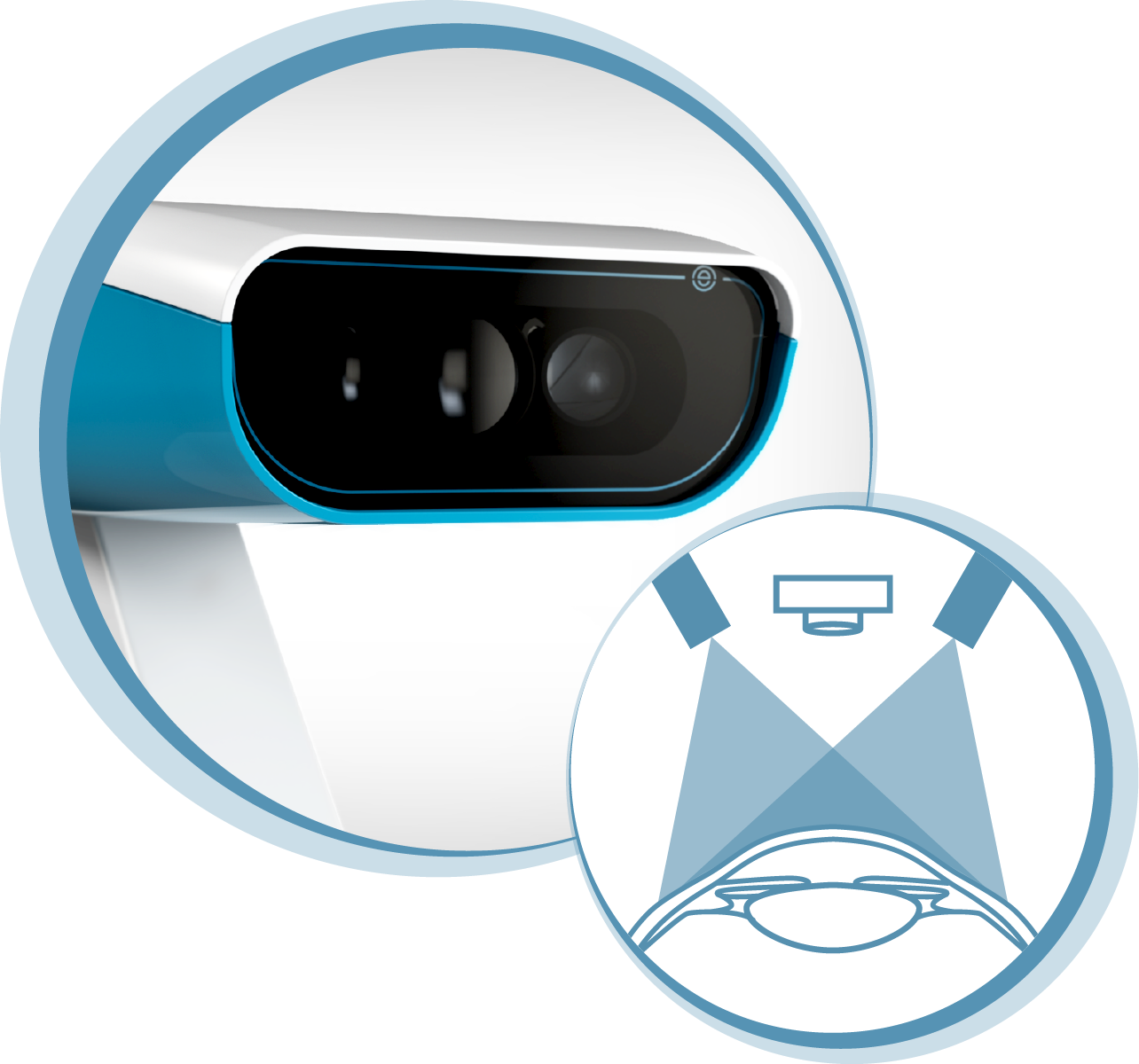
The Eye Surface Profiler (ESP) uses fringe projection to build a 3D height map of up to 20 mm of the ocular surface in one capture, from more than 500,000 data points. The patient looks straight ahead, and the ESP records the entire cornea, limbus, and sclera at once. Because nothing needs to be aligned or merged afterwards, there is no stitching step that could introduce error.
What the study found
Researchers at the University of Liverpool, Pacific University and partner institutions compared the ESP with a five-gaze stitching topographer (the Medmont Meridia) in 38 healthy subjects. Using the ESP as the single-shot benchmark, they found:
- ESP measurements are highly repeatable. Repeated scans of the same eye agreed to within about 4 µm.
- Stitching moved the map away from the single-shot benchmark. The stitched composite differed from the ESP surface by about 53–57 µm, more than twice the difference seen for a single straight-ahead image (23–27 µm).
- Gaze changes added further error. Images taken while the patient looked up, down, left or right differed from the ESP surface by up to 98 µm.
The authors attribute this to the demands of stitching: aligning and merging several images, edge artefacts, and changes in the tear film between shots.
Why it matters
The authors conclude that single-shot profilometry offers a more straightforward way to measure the eye. In their words, in substance, it boosts accuracy by avoiding the complications of image registration, speeds up the process, and makes the experience more comfortable for patients. They describe it as a more efficient method for precise corneal surface assessment and a significant improvement over traditional topography stitching.
They also caution that stitched data may carry errors in the central zone, which matters for lens-fitting software and for any research that relates central and peripheral areas of the eye. A single-shot map avoids that concern.
The takeaway
When the goal is an accurate, wide-field picture of the eye surface, capturing it in one measurement is a sound approach. The study supports single-shot profilometry as a reliable, efficient foundation for contact lens fitting and ocular surface research.
Lastly, although the study tested a Placido-based stitching system, the same question applies to any multi-capture Scheimpflug technology: more captures mean more registration steps and a longer measurement, whereas the ESP records the whole surface in one shot.
Lin W.-P., Wu L.-Y., Lin W.-R., White L., Wu R., Fathy A., Alanazi R., Davies J., Abass A. To Stitch or Not to Stitch, That Is the Question: Multi-Gaze Eye Topography Stitching Versus Single-Shot Profilometry. Photonics 2025, 12, 318. https://doi.org/10.3390/photonics12040318 (open access, CC BY).
Book a demo of the
Eye Surface Profiler
To find out more about the most comprehensive contact lens fit