
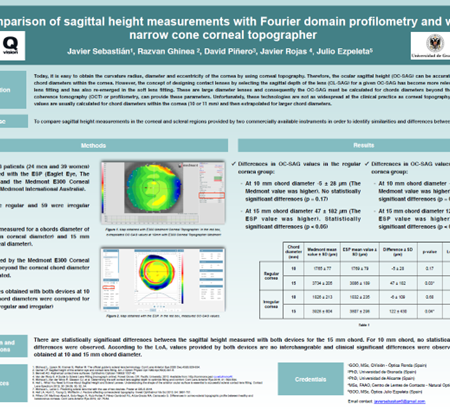
Comparison of sagittal height measurements with Fourier domain profilometry and with narrow cone corneal topographer
Javier Sebastián, GOO, MSc; Razvan Ghinea, PhD; David Piñero, PhD; Javier Rojas, MSc, FAAO; Julio Ezpeleta, GOO, MSc. Values provided by both devices are no interchangeable and clinical significant differences were observed. View Poster >>
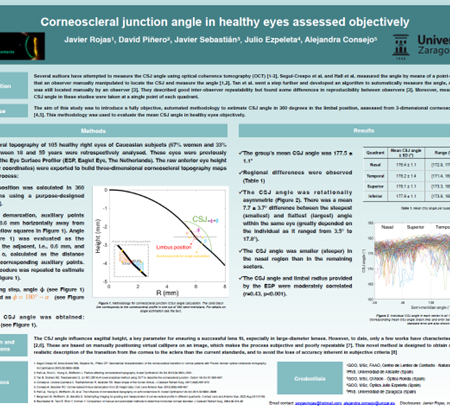
Corneoscleral junction angle in healthy eyes assessed objectively
Javier Rojas, MSc, FAAO; David Piñero, PhD; Javier Sebastián, GOO, MSc; Julio Ezpeleta, GOO, MSc; Alejandra Consejo, PhD. The corneoscleral junction angle influences sagittal height, a key parameter for ensuring a successful lens fit, especially in large-diameter lenses. View Poster >>
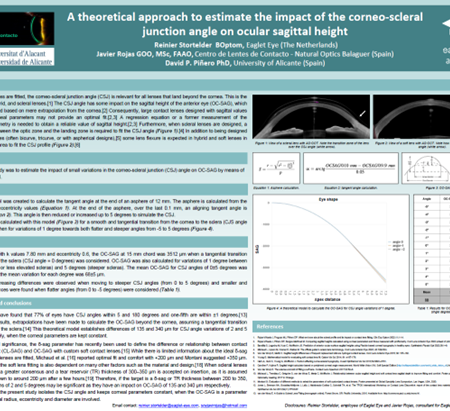


Incorporating a Bi-Elevation Design for Improved Scleral Lens Centration
Germán Aparicio, OD; Lindsay A. Sicks, OD, FAAO, FIACLE, FSLS Scleral lens centration is influenced by several factors including the corneal sagittal height, limbal shape, and scleral shape. All these factors can be assessed using corneal and scleral Profilometry. View Poster >>